For construction machinery operating year-round in mines, construction sites, and deserts, the cab serves not only as the driver’s “command center” but also as a “safe haven” shielding them from wind, rain, and extreme environments. The cab air conditioning system, as the core component ensuring this sanctuary’s comfort, faces far harsher challenges than those encountered in passenger vehicles: exposure to temperatures exceeding 60°C (140°F), swirling dust and sand, relentless intense vibrations, and sub-zero temperatures plunging below -20°C (-4°F). Under such conditions, ordinary air conditioning systems often fail prematurely, suffering from heat dissipation issues, compromised seals, and component damage.
Why can some air conditioners operate stably for years under harsh conditions? What’s the secret behind their rugged durability? As a professional manufacturer with years of expertise in engineering machinery cab air conditioning systems, Xuzhou Xinrun Intelligence Technology Co., Ltd. has analyzed thousands of real-world cases and leveraged extensive R&D experience to dissect the three core technologies tailored for extreme operating environments. We now unveil the secrets behind the rugged durability of cab air conditioning systems.
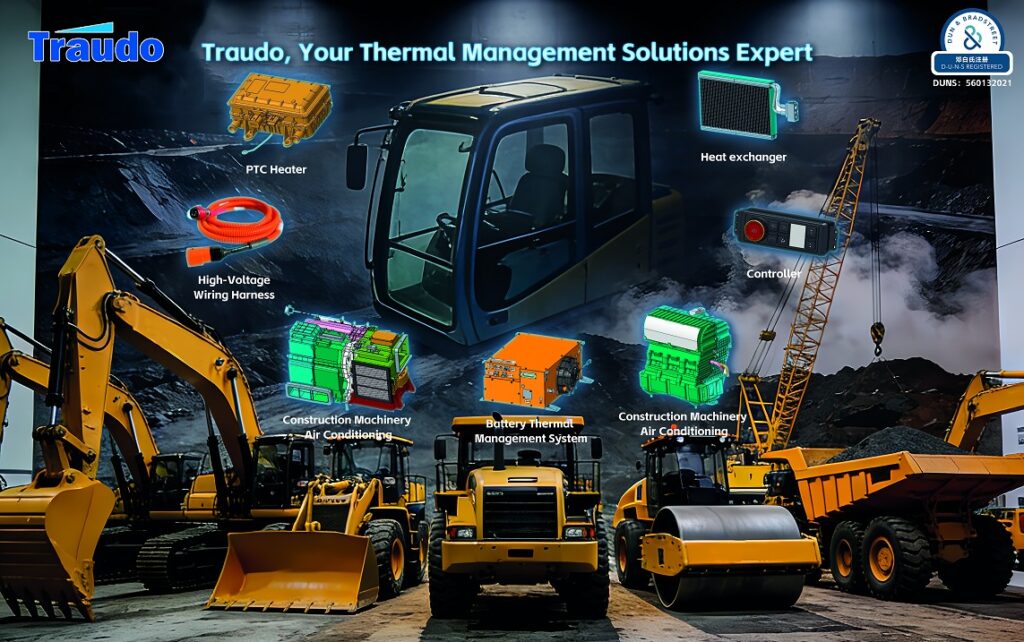
I.Enhanced Protection Technology: IP67+ Sealing, Building a Robust “Protection Shield” for Harsh Environments
The defining characteristics of construction machinery operating environments are “dirty, messy, and harsh”—dust in mines, mud on construction sites, and sand in deserts. Once these contaminants enter the air conditioning system, they clog pipes, wear down components, and cause the AC to fail. Therefore, “sealed protection” is a fundamental requirement for construction machinery cab air conditioning systems and represents one of the core differences between them and passenger vehicle AC systems.
Xuzhou Xinrun’s construction machinery cab air conditioners feature a comprehensive sealing protection design, achieving a core protection rating of IP67 or higher. Specifically, at the interfaces between the air conditioner housing and piping, fluororubber seals resistant to high and low temperatures and aging are employed. Combined with a precision snap-fit sealing structure, this ensures all-around dust and water resistance. Core heat exchange components like the condenser and evaporator are coated with anti-corrosion treatment, resisting dust adhesion while combating rust in humid conditions. Additionally, a high-efficiency dust filter module at the air intake captures over 95% of particulates, preventing dust ingress at the source. Field testing confirms this protective design ensures continuous, stable operation for over 5,000 hours in dusty, humid, and highly corrosive environments—significantly exceeding industry averages.
II.Weather-Resistant Temperature Control Technology: Wide Temperature Range Adaptation + Rapid Response for Extreme High and Low Temperatures
Construction machinery operates in environments with extreme temperature fluctuations. Surface temperatures at mining sites can exceed 60°C in summer, while northern construction sites can drop to -25°C in winter. This demands exceptionally wide temperature control ranges and rapid response times from air conditioning systems. Conventional air conditioners typically operate within a range of -10°C to 40°C, rendering them ill-suited for such extreme conditions.
To address this pain point, Xuzhou Xinrun has developed wide-temperature-range adaptation technology, extending the air conditioner’s effective operating temperature range to -30°C to 65°C. In high-temperature environments, the optimized condenser structure design increases heat exchange area. Combined with a high-efficiency inverter compressor and a high-flow cooling fan, this rapidly enhances heat dissipation efficiency. Even at 60°C, it can stably deliver cool air, maintaining the cab temperature around 26°C. In extreme cold conditions, an upgraded low-temperature start module and auxiliary heating system utilize PTC ceramic heating technology. Combined with optimized cabin insulation design, this enables rapid startup at -25°C, raising the cabin temperature above 15°C within 10 minutes to ensure normal driver operations. Additionally, the air conditioning system incorporates intelligent temperature control algorithms. It automatically adjusts compressor power and fan speed based on ambient temperature and driver-set preferences, achieving precise temperature regulation while balancing energy efficiency and reduced consumption.
III. Vibration-Resistant Stabilization Technology: Reinforced Structural Design + Redundant Backup to Address Continuous Vibration Impacts
The vibration intensity during construction machinery operations far exceeds that of ordinary vehicles. The intense vibrations generated by excavators digging and loaders shoveling are directly transmitted to the cab. If the internal structure of the air conditioner is poorly designed, issues such as loose piping, component detachment, and broken weld points are highly likely to occur. Therefore, “vibration resistance and stability” is one of the core technical requirements for air conditioners in construction machinery cabs.
Xuzhou Xinrun enhances vibration resistance through structural design and component selection. Structurally, a “frame-reinforced structure” secures core components like compressors, fans, and piping within the air conditioner. High-elasticity vibration-damping pads between components and the frame effectively absorb over 90% of vibration impacts. Flexible joints are used at pipe connections to prevent fatigue fractures caused by vibration. For component selection, all core parts undergo rigorous vibration testing, with industrial-grade vibration-resistant products chosen—such as cooling fans tested for 100,000 vibration cycles without failure, and compressors featuring reinforced rotor designs to ensure stable operation in continuous vibration environments. Additionally, the system incorporates redundant backup mechanisms. Critical sensors and control modules are equipped with backup components. Should any component fail, the system swiftly switches to backup mode, maintaining essential air conditioning functionality and preventing disruption to the driver’s operations.
Conclusion: The essence of “durability” lies in precisely meeting the demands of specific scenarios.
The ruggedness of construction machinery cab air conditioning systems is never achieved through simple “thickening and reinforcement.” Instead, it stems from a deep understanding of harsh operating environments, enabling comprehensive upgrades in protection, weather resistance, and vibration tolerance through targeted technological R&D and product design. Xuzhou Xinrun Intelligence Technology Co., Ltd. consistently adheres to the philosophy of “pragmatism and truth-seeking,” remaining deeply rooted in the construction machinery sector. By focusing on users’ core pain points, the company integrates every “rugged” technology into every detail of its products.
From mines to construction sites, from scorching heat to bitter cold, Xuzhou Xinrun’s cab air conditioning safeguards every operator’s comfort and safety with proven technical expertise. If you’re seeking cab air conditioning solutions tailored for harsh conditions in your construction machinery, visit Xuzhou Xinrun Intelligence Technology Co., Ltd.’s official website or call us for consultation. We provide customized products and professional technical support.